
本文目录 9 个章节
自从defcon出过新版musl libc的pwn之后,感觉之后可能会有一波musl lib pwn,果然强网杯的时候就看到了。可以预见,之后可能就会有musl libc master pwn,这两天趁着空闲的时候大概看了一下musl libc的源码,简单的做了一下笔记:
Malloc
用户传入size之后,如果大于MMAP_THRESHOLD (#define MMAP_THRESHOLD 131052),会直接走mmap,这一部分暂时先略过。
size处理
和ptmalloc的main_arena一样,musl也有一个管理堆的结构,称为malloc_context:
struct malloc_context {
uint64_t secret;
#ifndef PAGESIZE
size_t pagesize;
#endif
int init_done;
unsigned mmap_counter;
struct meta *free_meta_head;
struct meta *avail_meta;
size_t avail_meta_count, avail_meta_area_count, meta_alloc_shift;
struct meta_area *meta_area_head, *meta_area_tail;
unsigned char *avail_meta_areas;
struct meta *active[48];
size_t usage_by_class[48];
uint8_t unmap_seq[32], bounces[32];
uint8_t seq;
uintptr_t brk;
};其中struct meta *active[48]和bins类似,musl把chunk大小分为48类,用size_to_class进行计算:
const uint16_t size_classes[] = {
1, 2, 3, 4, 5, 6, 7, 8,
9, 10, 12, 15,
18, 20, 25, 31,
36, 42, 50, 63,
72, 84, 102, 127,
146, 170, 204, 255,
292, 340, 409, 511,
584, 682, 818, 1023,
1169, 1364, 1637, 2047,
2340, 2730, 3276, 4095,
4680, 5460, 6552, 8191,
};
#define IB 4
static inline int a_ctz_32(uint32_t x)
{
#ifdef a_clz_32
return 31-a_clz_32(x&-x);
#else
static const char debruijn32[32] = {
0, 1, 23, 2, 29, 24, 19, 3, 30, 27, 25, 11, 20, 8, 4, 13,
31, 22, 28, 18, 26, 10, 7, 12, 21, 17, 9, 6, 16, 5, 15, 14
};
return debruijn32[(x&-x)*0x076be629 >> 27];
#endif
}
static inline int a_clz_32(uint32_t x)
{
x >>= 1;
x |= x >> 1;
x |= x >> 2;
x |= x >> 4;
x |= x >> 8;
x |= x >> 16;
x++;
return 31-a_ctz_32(x);
}
static inline int size_to_class(size_t n)
{
n = (n+IB-1)>>4;
if (n<10) return n;
n++;
int i = (28-a_clz_32(n))*4 + 8;
if (n>size_classes[i+1]) i+=2;
if (n>size_classes[i]) i++;
return i;
}
这代码看上去挺复杂的,但是简单的跑一下就能得到一张对应表:
0x0 ~ 0xc ->0
0xd ~ 0x1c ->1
0x1d ~ 0x2c ->2
0x2d ~ 0x3c ->3
0x3d ~ 0x4c ->4
0x4d ~ 0x5c ->5
0x5d ~ 0x6c ->6
0x6d ~ 0x7c ->7
0x7d ~ 0x8c ->8
0x8d ~ 0x9c ->9
0x9d ~ 0xbc ->10
0xbd ~ 0xec ->11
0xed ~ 0x11c ->12
0x11d ~ 0x13c ->13
0x13d ~ 0x18c ->14
0x18d ~ 0x1ec ->15
0x1ed ~ 0x23c ->16
0x23d ~ 0x29c ->17
0x29d ~ 0x31c ->18
0x31d ~ 0x3ec ->19
0x3ed ~ 0x47c ->20
0x47d ~ 0x53c ->21
0x53d ~ 0x65c ->22
0x65d ~ 0x7ec ->23
0x7ed ~ 0x91c ->24
0x91d ~ 0xa9c ->25
0xa9d ~ 0xcbc ->26
0xcbd ~ 0xfec ->27
0xfed ~ 0x123c ->28
0x123d ~ 0x153c ->29
0x153d ~ 0x198c ->30
0x198d ~ 0x1fec ->31
0x1fed ~ 0x247c ->32
0x247d ~ 0x2a9c ->33
0x2a9d ~ 0x331c ->34
0x331d ~ 0x3fec ->35
0x3fed ~ 0x490c ->36
0x490d ~ 0x553c ->37
0x553d ~ 0x664c ->38
0x664d ~ 0x7fec ->39
0x7fed ~ 0x923c ->40
0x923d ~ 0xaa9c ->41
0xaa9d ~ 0xccbc ->42
0xccbd ~ 0xffec ->43
0xffed ~ 0x1247c ->44
0x1247d ~ 0x1553c ->45
0x1553d ~ 0x1997c ->46而在找到用户传入的size对应的active之后,会从对应的索引中取出meta结构:
struct meta {
struct meta *prev, *next; // meta是一个双向链表
struct group *mem;
volatile int avail_mask, freed_mask;
uintptr_t last_idx:5;
uintptr_t freeable:1;
uintptr_t sizeclass:6;
uintptr_t maplen:8*sizeof(uintptr_t)-12;
};当然,如果还没有申请过对应大小的meta时,取出来的meta会是0。在meta为0时,会尝试以一种比较粗略的方式进行索引(这段逻辑有点迷,感觉是找一个附近的meta进行后续分配):
// use coarse size classes initially when there are not yet
// any groups of desired size. this allows counts of 2 or 3
// to be allocated at first rather than having to start with
// 7 or 5, the min counts for even size classes.
//如果取出来meta的是空的,且索引在[4,32)之间,且不为6,且为偶数索引,
if (!g && sc>=4 && sc<32 && sc!=6 && !(sc&1) && !ctx.usage_by_class[sc]) {
size_t usage = ctx.usage_by_class[sc|1];
// if a new group may be allocated, count it toward
// usage in deciding if we can use coarse class.
if (!ctx.active[sc|1] || (!ctx.active[sc|1]->avail_mask
&& !ctx.active[sc|1]->freed_mask))
usage += 3;
if (usage <= 12)
sc |= 1;
g = ctx.active[sc];
}查找内存
在找到meta之后,会在meta的可用内存中进行查找:
for (;;) {
mask = g ? g->avail_mask : 0;
// 这个运算挺巧妙的,可以获取最低一位为1的值,比如3的二进制是011,最低位是1,4的二进制是100,最低一位就是4,简而言之就是获取了首个能用的内存对应的索引
first = mask&-mask;
if (!first) break;
//下面这个就是把这个内存取出来,只不过分为有锁的和无锁的
if (RDLOCK_IS_EXCLUSIVE || !MT)
g->avail_mask = mask-first;
else if (a_cas(&g->avail_mask, mask, mask-first)!=mask)
continue;
//测了一下这个函数好像是log[2,first],相当于把first转换成正常一点的索引
idx = a_ctz_32(first);
goto success;
}当然,也存在找不到可用的内存的情况,这时候会进入alloc_slot函数中的try_avail继续查找:
static int alloc_slot(int sc, size_t req)
{
uint32_t first = try_avail(&ctx.active[sc]);
if (first) return a_ctz_32(first);
struct meta *g = alloc_group(sc, req);
if (!g) return -1;
g->avail_mask--;
queue(&ctx.active[sc], g);
return 0;
}在try_avail中,会确认当前的avail_mask为0,假如当前的meta也没有free的chunk(freed_mask为0),那么就会从meta的链表中取出来,这个取出来的操作就是最传统的unsafe unlink,这里脱链可能是为了把这种没有空闲内存的meta拿走,减少搜索的时间。
uint32_t mask = m->avail_mask;
if (!mask) {
if (!m) return 0;
if (!m->freed_mask) {
dequeue(pm, m);
m = *pm;
// 脱链之后pm已经指向next了
if (!m) return 0;
} else {
//但是为啥这里要往后搜索一个。。。。
m = m->next;
*pm = m;
}
mask = m->freed_mask; // skip fully-free group unless it's the only one
// or it's a permanently non-freeable group
//前面这个条件确实没看懂,看注释可能是跳过完全被free的组?尽量去选择没有被完全利用的组吗
//可能是完全被free的组应该还给操作系统了吧
if (mask == (2u<<m->last_idx)-1 && m->freeable) {
m = m->next;
*pm = m;
mask = m->freed_mask;
}
之后会进行一个尝试激活meta中的内存的操作:
// activate more slots in a not-fully-active group
// if needed, but only as a last resort. prefer using
// any other group with free slots. this avoids
// touching & dirtying as-yet-unused pages.
// ((2u<<m->mem->active_idx)-1))相当于建立了一个mask
// 比如idx是3,那建立出来的就是0b1111
if (!(mask & ((2u<<m->mem->active_idx)-1))) {
if (m->next != m) {
// 不是很懂这里怎么还要取一个next
m = m->next;
*pm = m;
} else {
// 这里应该是一个拓展内存的操作?
int cnt = m->mem->active_idx + 2;
int size = size_classes[m->sizeclass]*UNIT;
int span = UNIT + size*cnt;
// activate up to next 4k boundary
while ((span^(span+size-1)) < 4096) {
cnt++;
span += size;
}
if (cnt > m->last_idx+1)
cnt = m->last_idx+1;
m->mem->active_idx = cnt-1;
}
mask = activate_group(m);
assert(mask);
decay_bounces(m->sizeclass);static inline uint32_t activate_group(struct meta *m)
{
assert(!m->avail_mask);
uint32_t mask, act = (2u<<m->mem->active_idx)-1;
do mask = m->freed_mask;
while (a_cas(&m->freed_mask, mask, mask&~act)!=mask);
// 扩充avail_mask?
return m->avail_mask = mask & act;
}最后会返回获取到的free_mask或者avail中的第一个chunk:
first = mask&-mask;
m->avail_mask = mask-first;申请内存
如果现有meta中找不到合适的chunk,那么就会进入alloc_group函数中进行申请,其中会调用alloc_meta来申请和进行meta的初始化:
//struct meta *alloc_meta(void) :
struct meta *m;
unsigned char *p;
//初始化ctx,就是获取一下secret
if (!ctx.init_done) {
#ifndef PAGESIZE
ctx.pagesize = get_page_size();
#endif
ctx.secret = get_random_secret();
ctx.init_done = 1;
}
size_t pagesize = PGSZ;
if (pagesize < 4096) pagesize = 4096;
//尝试取一个空闲的meta出来
if ((m = dequeue_head(&ctx.free_meta_head))) return m;而如果此时avail_meta_count为0,就会开始新申请一片meta:(不为0的话直接就取avail_meta一个返回)
if (!ctx.avail_meta_count) {
int need_unprotect = 1;
// 这里可能是为了取brk的地址?
if (!ctx.avail_meta_area_count && ctx.brk!=-1) {
uintptr_t new = ctx.brk + pagesize;
int need_guard = 0;
// 获取一片内存
if (!ctx.brk) {
need_guard = 1;
ctx.brk = brk(0);
// some ancient kernels returned _ebss
// instead of next page as initial brk.
ctx.brk += -ctx.brk & (pagesize-1);
new = ctx.brk + 2*pagesize;
}
if (brk(new) != new) {
ctx.brk = -1;
} else {
//使用mmap申请一片内存
if (need_guard) mmap((void *)ctx.brk, pagesize,
PROT_NONE, MAP_ANON|MAP_PRIVATE|MAP_FIXED, -1, 0);
ctx.brk = new;
ctx.avail_meta_areas = (void *)(new - pagesize);
ctx.avail_meta_area_count = pagesize>>12;
need_unprotect = 0;
}
}
//不取brk的地址
if (!ctx.avail_meta_area_count) {
size_t n = 2UL << ctx.meta_alloc_shift;
p = mmap(0, n*pagesize, PROT_NONE,
MAP_PRIVATE|MAP_ANON, -1, 0);
if (p==MAP_FAILED) return 0;
ctx.avail_meta_areas = p + pagesize;
ctx.avail_meta_area_count = (n-1)*(pagesize>>12);
ctx.meta_alloc_shift++;
}
p = ctx.avail_meta_areas;
if ((uintptr_t)p & (pagesize-1)) need_unprotect = 0;
if (need_unprotect)
if (mprotect(p, pagesize, PROT_READ|PROT_WRITE)
&& errno != ENOSYS)
return 0;
// 更新ctx中的地址信息
ctx.avail_meta_area_count--;
ctx.avail_meta_areas = p + 4096;
if (ctx.meta_area_tail) {
ctx.meta_area_tail->next = (void *)p;
} else {
ctx.meta_area_head = (void *)p;
}
ctx.meta_area_tail = (void *)p;
//设置meta中的check
ctx.meta_area_tail->check = ctx.secret;
ctx.avail_meta_count = ctx.meta_area_tail->nslots
= (4096-sizeof(struct meta_area))/sizeof *m;
ctx.avail_meta = ctx.meta_area_tail->slots;
}在完成申请之后,会做一些size的调整?
struct meta *m = alloc_meta();
if (!m) return 0;
size_t usage = ctx.usage_by_class[sc];
size_t pagesize = PGSZ;
int active_idx;
if (sc < 9) {
while (i<2 && 4*small_cnt_tab[sc][i] > usage)
i++;
cnt = small_cnt_tab[sc][i];
} else {
// lookup max number of slots fitting in power-of-two size
// from a table, along with number of factors of two we
// can divide out without a remainder or reaching 1.
cnt = med_cnt_tab[sc&3];
// reduce cnt to avoid excessive eagar allocation.
while (!(cnt&1) && 4*cnt > usage)
cnt >>= 1;
// data structures don't support groups whose slot offsets
// in units don't fit in 16 bits.
while (size*cnt >= 65536*UNIT)
cnt >>= 1;
}
// If we selected a count of 1 above but it's not sufficient to use
// mmap, increase to 2. Then it might be; if not it will nest.
if (cnt==1 && size*cnt+UNIT <= pagesize/2) cnt = 2;如果size不够就会重新分配,之后再进行一些成员的初始化:
if (size*cnt+UNIT > pagesize/2) {
// check/update bounce counter to start/increase retention
// of freed maps, and inhibit use of low-count, odd-size
// small mappings and single-slot groups if activated.
int nosmall = is_bouncing(sc);
account_bounce(sc);
step_seq();
// since the following count reduction opportunities have
// an absolute memory usage cost, don't overdo them. count
// coarse usage as part of usage.
if (!(sc&1) && sc<32) usage += ctx.usage_by_class[sc+1];
// try to drop to a lower count if the one found above
// increases usage by more than 25%. these reduced counts
// roughly fill an integral number of pages, just not a
// power of two, limiting amount of unusable space.
if (4*cnt > usage && !nosmall) {
if (0);
else if ((sc&3)==1 && size*cnt>8*pagesize) cnt = 2;
else if ((sc&3)==2 && size*cnt>4*pagesize) cnt = 3;
else if ((sc&3)==0 && size*cnt>8*pagesize) cnt = 3;
else if ((sc&3)==0 && size*cnt>2*pagesize) cnt = 5;
}
size_t needed = size*cnt + UNIT;
needed += -needed & (pagesize-1);
// produce an individually-mmapped allocation if usage is low,
// bounce counter hasn't triggered, and either it saves memory
// or it avoids eagar slot allocation without wasting too much.
if (!nosmall && cnt<=7) {
req += IB + UNIT;
req += -req & (pagesize-1);
if (req<size+UNIT || (req>=4*pagesize && 2*cnt>usage)) {
cnt = 1;
needed = req;
}
}
p = mmap(0, needed, PROT_READ|PROT_WRITE, MAP_PRIVATE|MAP_ANON, -1, 0);
if (p==MAP_FAILED) {
free_meta(m);
return 0;
}
m->maplen = needed>>12;
ctx.mmap_counter++;
active_idx = (4096-UNIT)/size-1;
if (active_idx > cnt-1) active_idx = cnt-1;
if (active_idx < 0) active_idx = 0;
} else {
int j = size_to_class(UNIT+cnt*size-IB);
int idx = alloc_slot(j, UNIT+cnt*size-IB);
if (idx < 0) {
free_meta(m);
return 0;
}
struct meta *g = ctx.active[j];
p = enframe(g, idx, UNIT*size_classes[j]-IB, ctx.mmap_counter);
m->maplen = 0;
p[-3] = (p[-3]&31) | (6<<5);
for (int i=0; i<=cnt; i++)
p[UNIT+i*size-4] = 0;
active_idx = cnt-1;
}
ctx.usage_by_class[sc] += cnt;
m->avail_mask = (2u<<active_idx)-1;
m->freed_mask = (2u<<(cnt-1))-1 - m->avail_mask;
m->mem = (void *)p;
m->mem->meta = m;
m->mem->active_idx = active_idx;
m->last_idx = cnt-1;
m->freeable = 1;
m->sizeclass = sc;
return m;申请成功之后,就会直接把这个meta的第一个chunk对应的index取出来:
g->avail_mask--;
queue(&ctx.active[sc], g);返回用户使用的内存
经过前面的操作,我们也只是拿到了meta和对应的idx,最后还要通过enframe函数返回一个给用户使用的区块:
static inline size_t get_stride(const struct meta *g)
{
if (!g->last_idx && g->maplen) {
return g->maplen*4096UL - UNIT;
} else {
return UNIT*size_classes[g->sizeclass];
}
}
static inline void set_size(unsigned char *p, unsigned char *end, size_t n)
{
int reserved = end-p-n;
if (reserved) end[-reserved] = 0;
if (reserved >= 5) {
*(uint32_t *)(end-4) = reserved;
end[-5] = 0;
reserved = 5;
}
p[-3] = (p[-3]&31) + (reserved<<5);
// 低7位是idx, 高5位是reserved
}
static inline void *enframe(struct meta *g, int idx, size_t n, int ctr)
{
size_t stride = get_stride(g); // 获取一个内存区域的大小
size_t slack = (stride-IB-n)/UNIT;
unsigned char *p = g->mem->storage + stride*idx; // 计算对应idx的内存区域
// IB 是4 ,用作chunk的标识
unsigned char *end = p+stride-IB;
// cycle offset within slot to increase interval to address
// reuse, facilitate trapping double-free.
int off = (p[-3] ? *(uint16_t *)(p-2) + 1 : ctr) & 255;
assert(!p[-4]);
if (off > slack) {
size_t m = slack;
m |= m>>1; m |= m>>2; m |= m>>4;
off &= m;
if (off > slack) off -= slack+1;
assert(off <= slack);
}
if (off) {
// store offset in unused header at offset zero
// if enframing at non-zero offset.
*(uint16_t *)(p-2) = off;
p[-3] = 7<<5;
p += UNIT*off;
// for nonzero offset there is no permanent check
// byte, so make one.
p[-4] = 0;
}
*(uint16_t *)(p-2) = (size_t)(p-g->mem->storage)/UNIT; // 相对于缓冲区基地址的偏移?
// 当前chunk对应的索引
p[-3] = idx;
set_size(p, end, n);
return p;
}这个地方非常迷的就是他直接拿负数做索引还不给任何注释,只能大概归纳一下chunk的这几位的结构大概是:
struck chunk{
uint8 zero;
uint8 idx; // 低7位是idx, 高5位是reserved
uint16 offset;
char[] usermem; // <--用户拿到的内存
}free
有malloc当然也有free:P
指针转换
这一步主要是根据用户传进来的指针获取对应的meta:
static inline int get_slot_index(const unsigned char *p)
{
return p[-3] & 31;
}
static inline struct meta *get_meta(const unsigned char *p)
{
// 检查地址对齐
assert(!((uintptr_t)p & 15));
// 获取偏移
int offset = *(const uint16_t *)(p - 2);
// 获取chunk的idx
int index = get_slot_index(p);
//p[-4]不为0就从*(uint32_t *)(p - 8)获取偏移
if (p[-4]) {
assert(!offset);
offset = *(uint32_t *)(p - 8);
assert(offset > 0xffff);
}
//通过offset获取基地址
/*struct meta_area {
uint64_t check;
struct meta_area *next;
int nslots;
struct meta slots[];
};
这个时候的group结构是
struct group {
struct meta *meta;
unsigned char active_idx:5;
char pad[UNIT - sizeof(struct meta *) - 1];
unsigned char storage[];
};
*/
const struct group *base = (const void *)(p - UNIT*offset - UNIT);
const struct meta *meta = base->meta;
// 校验group的地址
assert(meta->mem == base);
// index小于等于last index
assert(index <= meta->last_idx);
// 当前chunk不是avail的状态
assert(!(meta->avail_mask & (1u<<index)));
// 当前chunk不是free的状态
assert(!(meta->freed_mask & (1u<<index)));
const struct meta_area *area = (void *)((uintptr_t)meta & -4096);
// 检查arena
assert(area->check == ctx.secret);
// 检查size
if (meta->sizeclass < 48) {
assert(offset >= size_classes[meta->sizeclass]*index);
assert(offset < size_classes[meta->sizeclass]*(index+1));
} else {
assert(meta->sizeclass == 63);
}
if (meta->maplen) {
assert(offset <= meta->maplen*4096UL/UNIT - 1);
}
return (struct meta *)meta;
}释放内存
在完成一系列check之后就要对chunk进行free了:
struct meta *g = get_meta(p);
int idx = get_slot_index(p);
size_t stride = get_stride(g);
//这里还是获取这个chunk的起始地址和末尾
unsigned char *start = g->mem->storage + stride*idx;
unsigned char *end = start + stride - IB;
get_nominal_size(p, end);// 根据reserved来算真实大小
uint32_t self = 1u<<idx, all = (2u<<g->last_idx)-1;
((unsigned char *)p)[-3] = 255;
// invalidate offset to group header, and cycle offset of
// used region within slot if current offset is zero.
*(uint16_t *)((char *)p-2) = 0;
// release any whole pages contained in the slot to be freed
// unless it's a single-slot group that will be unmapped.
if (((uintptr_t)(start-1) ^ (uintptr_t)end) >= 2*PGSZ && g->last_idx) {
unsigned char *base = start + (-(uintptr_t)start & (PGSZ-1));
size_t len = (end-base) & -PGSZ;
//这个系统调用知识盲区了,似乎就是释放这片区域的
if (len) madvise(base, len, MADV_FREE);
}
// atomic free without locking if this is neither first or last slot
//这里应该是把freed_mask对应的位 置位
// 但是这里并不会马上把freed转换为avail
for (;;) {
uint32_t freed = g->freed_maskd;
uint32_t avail = g->avail_mask;
uint32_t mask = freed | avail;
assert(!(mask&self));
if (!freed || mask+self==all) break;
if (!MT)
g->freed_mask = freed+self;
else if (a_cas(&g->freed_mask, freed, freed+self)!=freed)
continue;
return;
}最后会调用nontrivial_free:
static struct mapinfo nontrivial_free(struct meta *g, int i)
{
uint32_t self = 1u<<i;
int sc = g->sizeclass;
uint32_t mask = g->freed_mask | g->avail_mask;
//这个意思应该是所有的内存都是free的状态了?
if (mask+self == (2u<<g->last_idx)-1 && okay_to_free(g)) {
// any multi-slot group is necessarily on an active list
// here, but single-slot groups might or might not be.
if (g->next) {
assert(sc < 48);
int activate_new = (ctx.active[sc]==g);
dequeue(&ctx.active[sc], g);
if (activate_new && ctx.active[sc])
activate_group(ctx.active[sc]);
}
return free_group(g);
} else if (!mask) {
//如果mask是0那就给他重新插入到active的序列中
assert(sc < 48);
// might still be active if there were no allocations
// after last available slot was taken.
if (ctx.active[sc] != g) {
queue(&ctx.active[sc], g);
}
}
// 带锁的一个or操作?
a_or(&g->freed_mask, self);
return (struct mapinfo){ 0 };
}总结
整体看下来感觉最核心的点可能就是free的时候那一堆check了,如果能够伪造meta那应该会构造很多奇奇怪怪的效果,比如进入nontrivial_free进行一个unsafe unlink?不过这次分析感觉也比较粗略,大概画了几个图:
对于整体的数据结构大概是这个样子的:
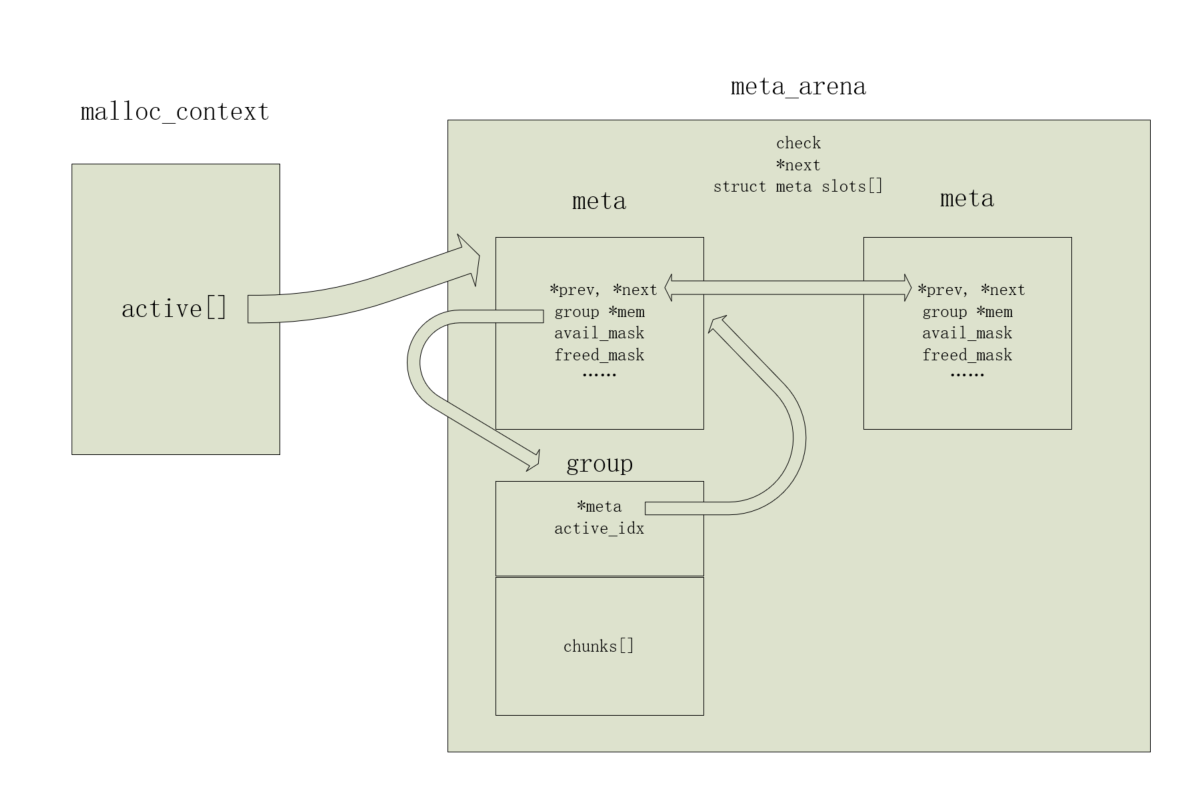
malloc和free的流程图感觉有点麻烦,等之后有空的时候再整理一下吧 orz
正在搬小板凳…